Product Management:
by the Book
📚 Instructional Case Study

This is a great case study to follow along and learn Product Management without the fluff.
I chose Uber as an example because most of us have used Uber.
Now, let's think of a world where we don't have Uber or any of the other ride hailing apps. This might be easier if you were in 2006.
Problem Space
Actor: Rider
An actor(Customer), in the context of product management represents a specific category of users who will interact with your future product.
Job to be done: Be Driven to a DEstination
A "Job to be Done" refers to the fundamental task that an actor (customer) wants to accomplish.
USe Cases
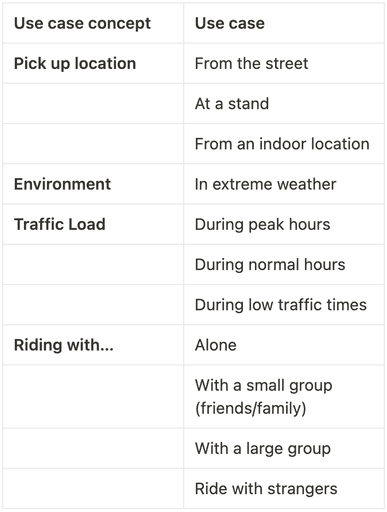
Use cases can be categorized with concepts. Such as pickup location.
Notice that back in 2006 people would go out in the main street to get a Cab.
Customer Discovery
Outcomes
An actor is successful when they achieve their desired outcomes.** Your product needs to help customers achieve their desired outcomes. i.e., better results and experiences. Each customer actor/role (user, buyer, etc.) is likely to have different desired outcomes. Do not associate goals with outcomes.
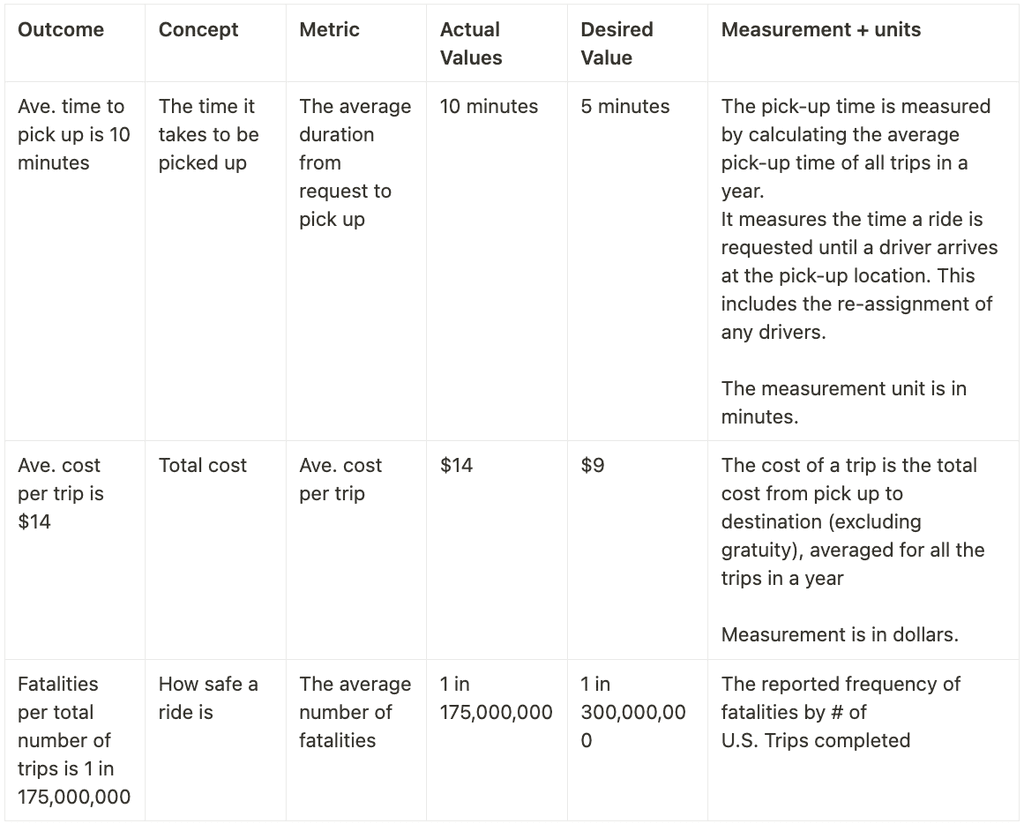
Some stats on Engineer behavior
To quantify outcomes effectively, various metrics can be utilized, such as:
Duration (Elapsed time to do something)
Effort to do something
Speed
Quantity
Delays, Wait time, Response time
Errors
Variation of actual outcomes
Material / resources wasted
Degree of risk
Decision quality
Customer Discovery
PRoblem
The problem is defined as The gap between the actual outcomes the actors getting doing the job and the desired outcomes is the problem. It is also known as opportunity.
Problem 1: Pick up time
Actual: Ave. time to pick up is 10 minutes
Desired: Ave. time to pick up is 5 minutes
Problem: 5 minutes
Problem 2: Cost
Actual: Ave. cost per trip is $14
Desired: Ave. cost per trip is $9
Problem: $5
Problem 3: Fatalities
Actual: Fatalities per total number of trips is 1 in 175,000,000
Desired: Fatalities per total number of trips is 1 in 300,000,000
Problem: 1 in 125,000,000
Market Research
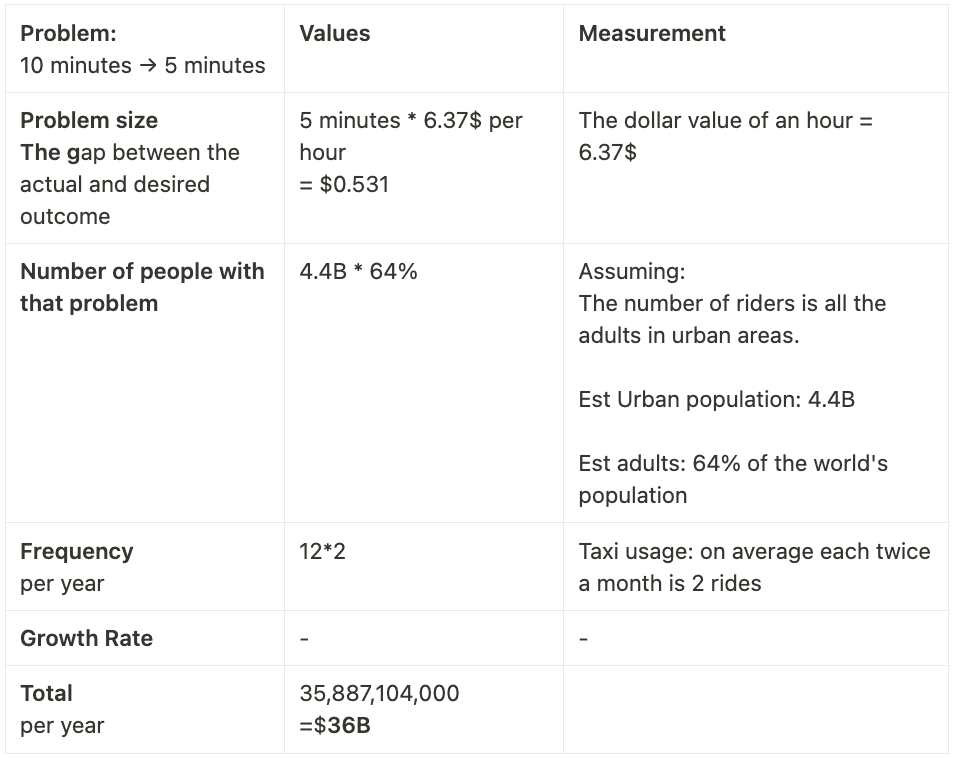
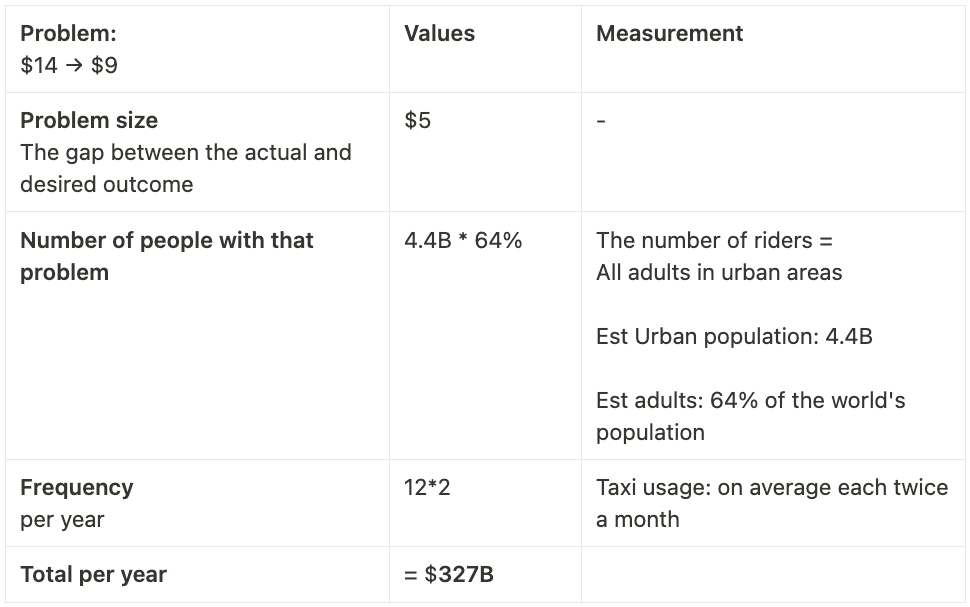
Problem Sizing
To build a compelling case for this new initiative, I needed to present a solid business argument to my leadership.
Here's what I found:
Recruitment trends indicated an upswing in hiring — encouraging news for us.
The market for software onboarding products was valued at $2 billion. Within this market, our target was a niche at the crossroads of engineering, learning — A sizeable chunk.
Educative had an already established catalog of courses for engineers. — This was Educative's unfair advantage.
Idea: Everything can be quantified but not (always) directly.
We can break down into categories of metrics:
Performance metrics
Behavioral metrics: running an effective meeting → (proxy)utilization of best practices rate
Sentiment metrics: A belief, attitude, feeling, user confidence rating, [survey] NPS
Simplified results of a rigorous competitive research
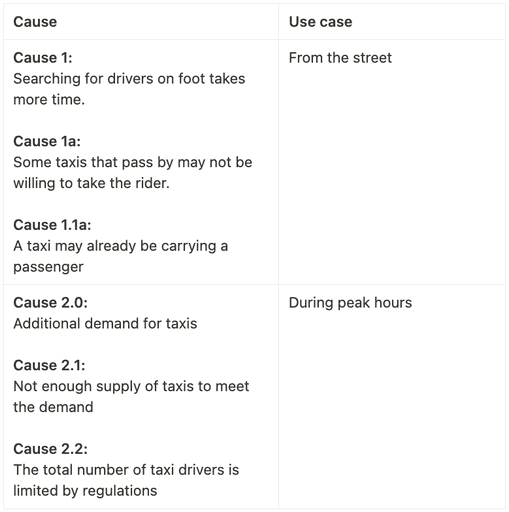
Causes
Problem Communication
Problem category: Ride Hailing problem
Problem statement: The rider’s desired outcome is to considerably reduce the time and effort spent on searching for a viable transport, currently a significant amount of time is spent looking for a cab or calling a cab service.
In attempt to capture the personality of each team member
Goals
Be the First Mover: In a rapidly evolving market, outpace emerging competitors.
Co-create with customers: Engaging customers directly in the product development process.
Build something you love: Launching only when the product demonstrably enhances our team's performance.
Solution Space: Part 1
Market Space
The key insight was: "Hiring Managers measure onboarding success in weeks.”
Daily tracking isn't productive for new hires and isn't practical for busy managers.
We created a linear weekly planning system with the following building blocks:
Tasks: Action items, ranging from signing documents to configuring GitHub.
Modules: A collection of company guidelines and technical knowledge, such as JavaScript best practices.
Connects: Interactions where new hires meet team members, facilitating knowledge transfer and comfort—vital during remote work conditions.


Solution Space: Part 2
Making onboarding SCalable
Measure What Matters: A dashboard provides clear visibility into onboarding status and challenges.
Now managers can focus on fostering connections in meetings and track individual progress in the background.

Solution Space: Part 3
Making plans in 3 2 1…
Hiring managers can now customize pre-made courses, stripping away excess material and incorporating company-specific information.
The ultimate goal was to enable the creation of an onboarding plan in under 30 minutes. Achieving this standard of "good" required multiple iterations.
[Update Nov 2021]: We added pre-built templates of common onboarding plans to make the experience even better.


MArketing
Landing Page
I partnered with the marketing team to:
Launch an onboarding landing page.
Make email marketing campaigns.
Develop personas for for targeted Marketing.

Impact
Reduced new employee onboarding time up to 33%, from 6 to 4 weeks.
50 enterprise customers to date.
50% increase in Annual Recurring Revenue (ARR)*.
The aftermath
Educative Onboarding is one of my biggest achievements to date, it has inspired me to push myself to build something that makes a change in someone's life.
👋 If you Made it this Far
Let's talk.
*I have omitted and obfuscated confidential information in this case study. All information in this case study is my own and does not necessarily reflect the views of Educative.